pyinf0
Abstract
fundamental (pitch) tracking using the probabilistic YIN method
Description
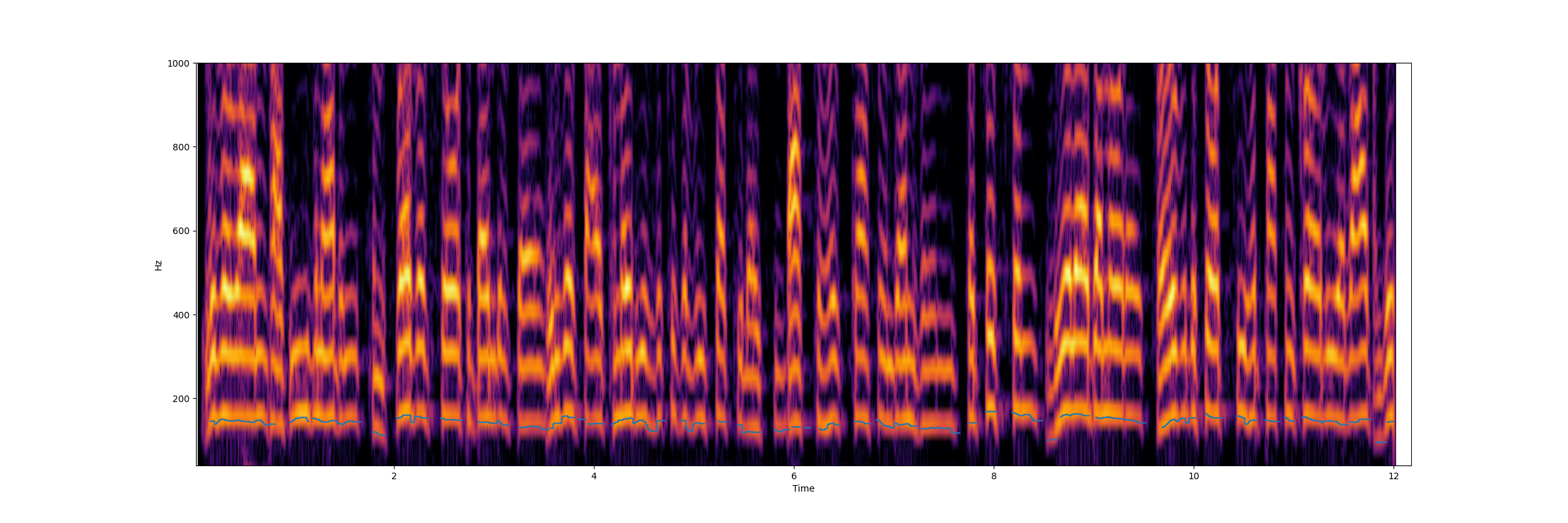
The pYIN algorithm is a two-stage pitch tracking method that improves upon the conventional YIN algorithm by incorporating probabilistic analysis using a Hidden Markov Model (HMM) to produce smoother, more accurate predictions.
- Pitch Candidate Generation: Unlike the original YIN algorithm, which outputs a single estimate per frame, pYIN generates multiple potential candidates along with associated probabilities.
- HMM-based Pitch Tracking: The probabilities and candidates are used as observations in a HMM. A Viterbi decoding process is then applied to determine the most likely sequence of pitches, which results in the improved pitch track.
On this streaming version only past observations are taken into account.
Syntax
kfreq, kconfidence, kvoiced pyinf0 asig, iminfreq=60, imaxfreq=1000, ibufsize=2048, ioverlap=4, ktransprob=0.99, ibins=4, kdrift=5
Arguments
- asig: audio signal
- iminfreq: min. frequency for f0 (default=60)
- imaxfreq: max. frequency for f0 (default=1000)
- ibufsize: size of the analysis frame (default=2048)
- ioverlap: overlapping frames. hopsize=bufsize/overlap (default=4)
- ktransprob: hmm transition probability (default=0.99)
- ibins: number of bins per semitone (default=4)
- kdrift: pitch drift between frames, in semitones (default=5)
Output
- kfreq: detected frequency. Only valid if confidence is > ~0.4
- kconfidence: detection confidence
- kvoiced: is the sound voiced
Execution Time
- Performance
Examples
<CsoundSynthesizer>
<CsOptions>
-odac
</CsOptions>

<CsInstruments>
sr     = 44100
ksmps  = 64
nchnls = 2
0dbfs  = 1

/* example file for pyinf0

Syntax:

kfreq, kconfidence, kvoiced pyinf0 asig, iminfreq=60, imaxfreq=1000, ibufsize=2048, ioverlap=4, ktransprob=0.99, ibins=4, kdrift=5

Args:
    * asig: audio signal
    * iminfreq: min. frequency for f0 (default=60)
    * imaxfreq: max. frequency for f0 (default=1000)
    * ibufsize: size of the analysis frame (default=2048)
    * ioverlap: overlapping frames. hopsize=bufsize/overlap (default=4)
    * ktransprob: hmm transition probability (default=0.99)
    * ibins: number of bins per semitone (default=4)
    * kdrift: pitch drift between frames, in semitones (default=5)

Output:
    * kfreq: detected frequency. Only valid if confidence is > ~0.4
    * kconfidence: detection confidence
    * kvoiced: is the sound voiced

*/


instr 1
  asig1 = oscili:a(0.5, 500)
  asig2 = diskin2("finnegan01.flac", 1, 0, 1)[0]
  asig3 = buzz(0.1, 300, 7, -1)
  asig4 = pinker() * 0.1
  Snames[] fillarray "sine", "speech", "buzz", "pink"
  ksource init 0
  if metro(1/3) == 1 then
    ksource = (ksource + 1) % 4
  endif
  asig = picksource(ksource, asig1, asig2, asig3, asig4)
  kpitch, kconf, kvoiced pyinf0 asig, 60, 1000, 2048, 8, 0.9, 5
  ksound = schmitt(dbamp(rms(asig)),  -45, -55);
  kenv = schmitt:k(kconf, 0.03, 0.01) * ksound;
  if metro(12) == 1 then
    printsk "Source: %d, %s, pitch: %f, conf: %f, voiced: %f, sound: %d\n", ksource, Snames[ksource], kpitch, kconf, kvoiced, ksound
  endif
  outch 1, asig
  outch 2, vco2(0.1, kpitch) * a(kenv)
endin

</CsInstruments>

<CsScore>
i1 1 20

</CsScore>
</CsoundSynthesizer>
See also
Metadata
- Author: Eduardo Moguillansky
- Year: 2026
- Plugin: else
- Source: https://github.com/csound-plugins/csound-plugins/blob/master/src/else/src/else.c